Monks have a tradition of silence. Man is a social animal. Why was silence so important? How could such complex organisations as monasteries run without speech? In fact they did not and monks did not make a vow of silence. Instead from the 6th century many communities followed the Rule of St Benedict and from this it became common for chattering to be prohibited during religious services and practices, at mealtimes and overnight in the dormitory. Otherwise, as we shall see, speech was to be avoided except at strictly specified times. Exceptions would be made for monastic officials and in an emergency. So must then consider which language they would use. We will discover that this was in a variety of tongues supplemented by use of their hands!
From the earliest days of hermitic monasticism in Egypt silence was paramount. When communities were formed it is believed this continued. St Benedict in the 6th chapter of his Rule from 6th century Italy makes it clear that silence is a virtue, that speech is to be limited and furthermore “loose talk, idle words and talk that stimulates laughter ,we condemn this with a permanent ban in all places”. The Bible supplies plenty of examples of bridling the tongue and the value of silence. The monastic life was to be quiet and meditative and the house a place of silence. The Devil worked through idle chatter. Voices should only be raised in prayer and praise. Meals were to be taken silently broken only by one of their number reading aloud from an ‘improving’ book eg saints’ lives. Keeping silent avoided the sins of the tongue.
It is always difficult to generalise about anything for all Orders in all periods, and the practice of silence is no exception. However the Rule of Benedict can be seen as the common source for practice in Europe.There would always be times and places when speech was allowed and it was a matter of degree and custom. If we consider the main medieval monastic orders (Benedictine, reformed Benedictine or Cluniac, Cistercian, Carthusian) and the so-called mendicant orders who went out into the world preaching etc.(Franciscans, Dominicans, Augustinians, Carmelites) they all valued silence.
The Benedictines, and later the Cluniacs and Cistercians, aimed to follow the Rule of St Benedict. Chatter was to be avoided during services, Through musical chant, the Cluniacs believed they were imitating angels. Meals were to be silent save for the chosen readings of the day. At night there was to be silence in the dormitory. Silence was prescribed in the kitchen and the Infirmarer was only to speak if treating a patient. This all sounds harsh and incredible to us now. In practice there must have been exceptions and breaches of discipline. The Abbott and Prior were allowed to speak as necessary and senior officials could as part of their job eg to workmen or guests. In emergencies like the fire at Bury St Edmunds Abbey on 23/June 1195 the alarm had to be raised by a gong and pandemonium followed as the shrine went up in flames.
The Cistercians decried unnecessary speech in the daily Chapter meeting and in places of labour.e.g.cloister. In the Refectory silence at the Abbot’s table(except with guests).Incidentally Cistercian nuns had to be silent at meals and at night, following the Rule. In 1242 the Cistercian General Chapter decreed that no nun was to speak with anyone outside of their Convent except through a heavily barred window. Conversation by certain Cistercian conversi (lay brothers) was supposedly controlled too. Amazingly at rural granges (Cistercian farms) dialogue by lay brother farm workers with travellers was to be limited to a greeting or give to give directions!
 |
| Warming room at Lacock Abbey |
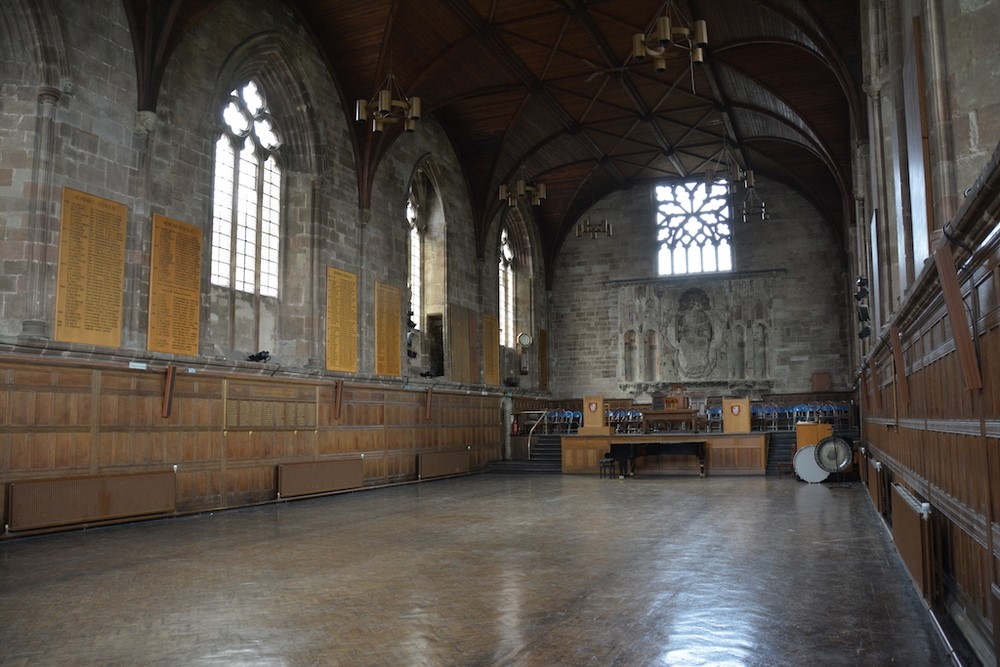
So where and when was conversation allowed? In Benedictine foundations the warming room was the most likely place allowing some conversation. Along with the kitchen and the infirmary it contained a fireplace and they could talk there for limited periods. Was this like the Common Room in a University Hall? Certainly this must have been an attractive spot with its fire. It seems that during periods of particular seriousness like Lent conversation was even forbidden in the warming room. Lacock Abbey in Wiltshire has a good surviving example of a warming room. Daily Chapter was where matters for the day and discipline were aired with the whole assembly of monks present , and were strictly regulated. Protocol demanded that only one monk was to speak at a time. There was no side chatter. but there might be a chance of debate. This went too far at St Mary’s Abbey in York in October 1132 when two factions rowed over observances, and the prior’s reforming party had to be ejected. from the meeting. Here St Albans in Abbot William of Trumpington came under criticism from his monks over alleged associations with laymen and his exile of some of our monks to abbey daughter houses..
By special permission conversation might occur in the cloister. In the time after Chapter in the morning before the late morning office of Sext it became accepted that monks could converse. Sometimes when monks were working in the cloister in outdoor study silence might be broken, but it might be limited to reciting psalms or spiritual topics. For example the Cluniacs by custom allowed this which led to the 12th century Cistercian, Idung of Prufening, to claim this deteriorated into rowdiness comparable to a tavern. (He may have been rather biased.....the Cistercians did not approve of many Cluniac practices). There was some relaxation too after the regular bloodletting which all monks had to undergo several times a year to restore balance in their body, clear the brain and curb sensual feelings.
The Carthusians, each living in their own cell only seem to have sanctioned relaxation of the rule of silence on Sundays and Church feast days with one hour of conversation in the cloister, including with visitors. If a monk died consolation could be given.
Monasteries would often fall short of the ideal place of silence, peace and tranquility. First, every monastery would be frequently disturbed by the amount of building work which must have gone on during the summer season when work could be undertaken. Towers and walls fell down ; there was essential repair work ; extensions needed because of extra numbers, keeping up with changing architectural styles and the whim of the abbot. Changes made here at St Albans after the October 1323 collapse of part of the nave of the church and various extensions to visitor accommodation must have been very noisy and disruptive Second, the Rule laid down hospitality to visitors as a primary duty. If a monastic house became renowned for this, disruption and noise could be expected. This was particularly true at St Albans and caused continual financial problems. Third, if a house was on a pilgrimage route favoured by the King or ruling class it would suffer disruption.. St Albans had all three of these disadvantages.
If we accept that Abbots and Priors and other key officials were allowed to speak for purposes of administration and with guests, and the ordinary monks were constrained to speak only as above, some other method of communication was needed. It likely involved meals. Think “will you pass the salt” and hand signals were the solution. John of Salerno (a 13th century Dominican) reckoned this language was “of the fingers and eyes”. St Benedict himself said in Rule 38”whatever is wanted for eating and drinking the brethren should pass one to another, so that no one need ask for anything.If, however, something is wanted, it should be asked for by some sign or sound rather than by speaking”. What developed via hand signals is not truly a sign language. It is not related to the rather amusing current contortions of sign linguists we see added to some national news channels.They use a version of a language for the deaf, the first of which did not appear until the 16th century. We are concerned with a visual kinetic system of communication by gestures for monks with normal hearing..
 |
Cluny Abbey : a model showing the whole site at its greatest extent in
the 12th century |
It is generally held that hand signals were first used by monks in Burgundy from the 10th century and were in use at the Cluny Abbey during the abbacy of St Odo (926-942).Cluny produced a sign collection upon which all others were subsequently based. Lists of hand signals from the 11th century have been found in the customaries of Bernhard (1075) and Ulrich (1083).for use in the instruction of novice monks There are 118 signals in this sign lexicon ( list) Each sign indicates how it should be made and gives a rationale. For example “For the sign of bread, make a circle using the thumbs and index fingers, the reason being the bread is usually round.” From such descriptions we can gain useful information about their way of life. The list is divided into four groups : food, clothing, the Divine Office and a miscellaneous group covering people, officials, actions, and some abstract concepts. It is mainly a list of nouns, very few verbs and no pronouns or ways of connecting signals. This is consistent with monastic discipline : only having signals to cover the most basic everyday needs (e.g. at table) and for instruction and reprimand. The largest list with 359, many of which relate to food, was by William of Hirsau for the monastery there.
The oldest and most famous English list came from mid 11th century Christ Church Canterbury. It is the only list in the vernacular Old English and is bound together with a copy of the Rule of St Benedict also in Old English. It is held in the British Library as MS Cotton Tiberius A iii. This lexicon has 127 hand signals, many originating from Cluny. These are common items and everyday actions. The list can be divided as follows:-
1-7 Officials e.g. 4 cellarer
8-28 Books vestments for Mass e.g. 13 vestment
29-43 Other church service books e.g. 29 bible
44-48 Chapter house e.g. 48 scourge
49-86 Refectory food and drink e.g. 72 oyster
87-110 Clothing and personal items e.g. 100 comb, 98 soap . 102 underpants.94 toilet.
111-117 Cloister activities e.g.114 large writing tablet
118-127 Outside persons e.g.126 layman
I had fun taking some pictures with the help of my wife. The bread sign was pretty universal indicating circular bread or rolls which may have been the most common. The knife sign should be compared to the Ely one later : very similar. The clasping of hands together seemed to me perfect for expressing the joy of a mug or two of beer. The grasping of the stomach indicated that the monk needed the toilet possibly with a strained expression...
 |
| Canterbury #54 Bread |
 |
| Canterbury #55 Knife |
 |
| Canterbury #85 |
 |
| Canterbury #94 Toilet |
Comparison of the Cluny original with the Canterbury one shows a more varied diet at Cluny but local favourites at Canterbury like plums, oysters, sloe berries and beer. Gerald of Wales experienced the feast of the Holy Trinity at Christ Church Canterbury in 1180 and was far from impressed. “There were the monks...all of them gesticulating with fingers, hands and arms, and whistling one to another in lieu of speaking, all extravagating in a manner more free and frivolous than was seemly” He compared it to a dumbshow and thought it would have been less distracting if they had spoken to each other. It is interesting to note the whistling and remember Benedict had said “some sign or sound rather than by speaking”. I wonder what other sounds may have been used. More research?
By the 16th century most houses will have written down their own local rules and practices in what are called Customaries. These might include hand signal lexicons. Few have survived. There are two from Bury St Edmunds, one from the Victorine canons of St Thomas’ Abbey Dublin, one from the Briggetine nouns at Syon.
 Perhaps the most interesting list is from Ely Cathedral Priory in the 14th century. It is quite similar to the Canterbury list and again is mainly nouns, a few adjectives and verbs, This guide from David sherlock is invaluable. He also wrote other articles and was a prominent local historian around Bury St Edmunds.
There are 109 signals which can be divided as follows:-
1-15 Divine Office e.g. 1 book 2 missal
16-47 Food and drink e.g.16 bread
48-65 Clothing and personal items e.g.59 knife
66-71 Saints and martyrs e.g. 68 martyr
72-92 Monastic officials etc e.g.84 cellarer
93-109 Every day in the cloister. e.g.102 agreeing 103 disagreeing 107 something bad.
 |
| Ely #59 Knife |
 |
| Ely #108 Something bad |
It seems that sometimes in practice two signals were joined together. For example the sign for salmon would be preceded by the general sign for fish.
Ely #23 General sign for fish meant to be like a swimming fish.
Ely # I disagree - a flick of the fingers - hopefully not overused...
The Cistercians adopted hand signals in the 12th century and Cistercian lexicons have been found which are similar in content to the Cluny original. Indeed the Trappists (reformed Cistercians) were still using hand signals up to the 1960s employing a lexicon from 1624.. In 1152 the Cistercian General Chapter laid out punishments for those who used words rather than signals during meals. Visiting monks might be excused however through ignorance of local practice. Sometimes the lexicons were written in verse : the longest one has 216 signs. This may sound bizarre but it was likely a mnemonic device and may have helped novices to memorise them. There were some new signals : e.g. lay brothers, heretics, pagans. The lexicons were still mainly nouns so there was still fear of unnecessary use in cloister and dormitory through too many miscellaneous abstract signals, In a 13th century vision of Purgatory novice being made to see the terrible punishment awaiting them for misdeeds including using free-style sign language for lewd or stupid words.
Probably there were more signals which we do not now know about. The lexicons contain the official signals. We do not know about local practice. We can conjecture that some houses had more , the details of which were lost or never written down. The signals do not include pronouns but I believe they must have had simple methods of indicating who or what was intended by pointing for instance .There was a lot of common practice across monasteries and there are direct similarities in the Canterbury and Ely list. E.g.bread. This would have been helpful if monks moved to other houses. However local practice will have varied. We know this because visiting Cistercian monks who used unknown signals or speech would not be punished like the inmates.
Monastic foundations will have contained many of the most literate persons of the day. Latin was the language of liturgy and was universal across much of Christian Europe. Was it used in everyday monastic speech? After the Norman conquest in 1066 there were three major languages in use in England: Middle English, Anglo-Norman (like French) or Latin. Middle English began to develop from Old English from that time, and then in the 15th century into Early Modern English. The top monastic officials and scholars in monasteries will have been able to use Latin to converse in our period (1066-1540)It is very unlikely that others in monasteries could do so. How would it have been taught? Information about schooling and teaching of Latin to novices is hard to come by. Singing the liturgy and prayers do not necessarily imply understanding and would not be much help in the conduct of everyday life. Reading, understanding and speaking a language are different skills. Learning Latin would have been gruelling, as I well remember from six years study myself in a grammar school. Not all monks would be capable of it. It was therefore an elitist thing to be able to converse in Latin. I am convinced that Latin was not the language of the cloisters and the majority of conversation would have been in the vernacular (local language). The language for discussions at Morning Chapter would have been decided locally. Monks using their few valuable moments talking in the Warming Room will have used their most natural local language rather than do battle with the complexities of Latin grammar.