Thursday, May 14, 2020

Washing and Baths


The monks we see in films and modern television documentaries  invariably look clean and well-dressed. Cleanliness is next to Godliness we are told. In this blog we are talking about the Middle Ages. The concept of Roman public baths has been forgotten. The nobility  will have taken some baths and the concept of regular hand washing was not uncommon. Exceptionally King Edward I had running water in his bathroom and King Edward III was very proud of his hot and cold  running water.
So how about monks? Bearing in mind that monasteries were at the forefront of  the planning and construction of water supply installations. (see the famous plan of Canterbury)
Baths would be taken. Cluny, the top of the range 12th century French abbey, specified 2 baths per year  (Christmas and Easter). Archbishop Lanfranc spoke of 5 per year in late 11th century England. In general Benedictines seem to have taken 4 baths per year. This may have been less about heath and more about smell… At Westminster  in the later Middle Ages they took 4 baths (Christmas, Easter, end of June and end of September. Four monks would be done in a dayThere was little encouragement from St  Benedict in his Rule. He saw baths as for the sick and not a general perquisite. It is likely that sick monks will have been given more baths. Ailred, the famous 12th century  Cistercian ab bot of Rievaux once had as many as 40 baths in a day to relieve him of the pain of urinary stones. This was exceptional!
So how would a bath be organised? The chamberlain had to buy extra wood to heat the large amounts of water needed. This would be put into a large tub with sweet smelling hay on the floor round about. Imagine the amount of pots of water needed to fill the tub. Modesty seems to have been important. Apparently monks were expected to retain their braies ( kind of shorts acting as an undergarment which hung to the knees.) The Cistercians did not have these breeches and were made fun of as              Gilbertine nuns would cover up with linen.  Baths could be in in the cloister, but not for Cistercians.  I suspect in general  they will more likely have been in the warming room which could provide a degree of privacy and warmth..  Towels were provided. Cold baths may have been taken also as a way of calming lust  and the senses.
Soap was not unknown. Mentions of it occur from around 1000 and later soap making is reported in 13th century Coventry and also York and Hull. A type of white soap was made from fern ash and unslaked lime which had to stand for 2 days. It was then mixed with oil and tallow, heated and mixed with bean flour and made into cakes.
If baths were rare, hand and foot washing were frequent. There would be  a stone lavabo with nearby towel cupboard for this. It could be a rectangular trough situated near the frater doorway.  This might  have elaborate decorations and pinnacles, be lined with lead and filled up with brass inflows (taps) and emptied via drain pipes. Eg Hexham, Norwich, Cleve. Evidence of draining system is at Paisley Abbey in Scotland.


 It could be a more complex series of wash basins as in the famous cloister at Gloucester.(see below)


Cloister at Gloucester Cathedral.
(Flickr Damian Entwistle)


Our own lavabo at St Albans is likely to have been in the cloister, because the water supply ran under this. The cloister would have been 

The other type of lavabo was with a circular or polygonal base with a circle of taps from a central supply. Eg  Fountains, Canterbury, Durham, Exeter and Wenlock Priory. Eventually these circular lavabos  became more ornate eg Batalha, Portugal..


Wenlock Priory

Fountain at Batalha Monastery, Portugal.
(Flickr Creative Commons, by mbac)


Washing hands and feet was thought of as a spiritual  cleansing in addition to hygiene. It was common for monks to wash hands before their first entry into church for Lauds. At Cluny monks were expected to gather in the cloister each morning to wash. Three towels were available for the whole community (one for novices, one for professed monks and one for lay brothers). Washing hands before meals seems to have been de rigeur in all monasteries.. I imagine the towels getting wetter and wetter …  The fraterer had to sort out the cleaning  and removal of dirt from the lavabo. He also had to provide clean towels which were changed and placed in the cupboard Sunday and Thursday each week. Eg Fountains Abbey, Gloucester and Westminster.
Incidentally most people may have washed hands 5 times a day (before and after meals nb using a spoon and perhaps a knife but with much use of fingers....) Feet were washed weekly at the Maundy ceremony on Saturdays.


Thursday, April 9, 2020

Plague

This was not a topic I  had expected to write about. I thought the plague in 1349  was a huge onetime jolt for Medieval man. Nor did I expect that in 2020 we would be cooped up at home through a pandemic. Easter was a terrible time for monks here in St Albans in 1349. There is a story to tell, and the connections and parallels with today are uncanny and poignant. 

This is my take on what the plague meant to St Albans then and to us now in 2020. You will find it informative and relevant.

St Albans Cathedral - Wikiwand
The Abbey in the 1530s. The size in 1349 substantially the same but gatehouse here is a later replacement.


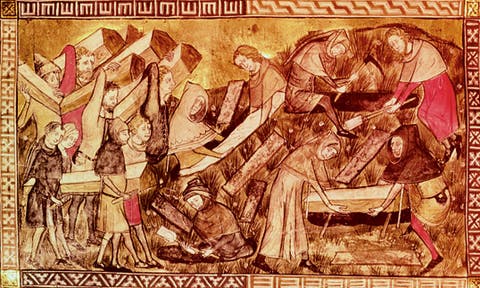
The so-called Black Death hit us in St Albans in spring 1349. On Maundy Thursday 9 April 1349 (671 years ago to the day) the Abbot  of St Albans Abbey, Michael de Mentmore felt unwell. He was a good man and an outstanding Abbot, so he insisted on celebrating High Mass in the early afternoon before dinner. He then washed the feet of  the local poor in keeping with the custom of the day. He also presided over the later daily offices and washed the feet of all his monks. This could have spread the disease. Anyway he was worse the next day, made his confession, received the last sacrament and died three days later on Easter Sunday 12 April 1349.

In the days following 47 out of about 100 monks died here in St Albans. The catastrophic death toll was due to all the following factors involving contact with visitors and local people who could be infected. Workers in the local hostelries,servants and lay brothers were open to infection. Being near London, pilgrims in large numbers would have been attracted to pray for help at the shrine of the first English martyr, St Alban. The Abbey was well known for offering hospitality and accomodation to  visitors. Monks from the Abbey were also engaged in administration of local justice, ministering to the sick in the Abbey Infirmary, hearing confessions and conducting funerals.All these activities made them very susceptible to infection..Finally living and worshipping in a closed large group put them in great danger. A sad  reward for doing good works.

The author standing beside St Albans Abbey on the site of St Andrew's Chapel which would have been his place of refuge had he lived in the same house in 1349.

The Black Death originated in China in 1346, travelling across Asia on trade routes to Asia Minor, and then across to Italy and  France by 1348. Reports had been received about the awful pestilence in Asia years before, but it was not going to bother us, so it was thought. This has a chilling familiarity for us today.

Where the plague spread in Europe there was a similar pattern of disaster. The appearance of the disease, exaggerated reports of deaths, and serious social and economic consequences. Nowhere escaped but some areas were hit particularly very badly :eg. Florence, Vienna and Avignon,  Bohemia and parts of Polan were less affected.. In England there few large towns: London was likely 60-70,00, then Norwich 13,000 and York 10,00. These were hit badly. 90% of England's population lived in villages. Some of these were more fortunate (:or example where I was born, in the Fens near the Wash) Overall the Black Death took as much as 40% of the population of England.

Containing Contagion: Perception and Prevention of Plague in the ...

Experts are still arguing over the exact nature of the plague of 1346-50. My tentative conclusion is that there were three forms which have been  described :
Bubonic – causing tumours
Pneumonic – attacking the respiratory system
Septicaemic – blood poisoning
Bubonic and septicaemic were passed on by flea bites. Pneumonic through airborne droplets of saliva coughed up by humans infected with bubonic or septicaemic types. These were all due to a bacteria called Yersinia pestis which used rats, fleas and humans as hosts. The bacteria would multiply inside the flea, blocking up the tube to its stomach, leading it to be hungry and to attack a rat or human. In that feeding process the plague bacteria got into the victim’s blood ; the bacteria became present in the victim's saliva, which could be transmitted by coughing or sneezing bacteria - laden droplets could enter  a new victim's windpipe and lungs.The flea would die but the plague bacteria had gained a new host. In the pneumonic variety the plague bacteria. The speed at which the Black Death spread astonished contemporaries. The resulting disease was foul smelling, degrading and disgusting.

Our 2020 COVID-19 is the latest virus from the Coronavirus family which can infect animals or humans and cause respiratory problems. Coronavirus is mainly spread by tiny droplets of saliva or discharge from the nose of an infected person who sneezes  or coughs. The droplets can then infect someone else immediately or land on surfaces or objects. By touching these and then touching either  their eyes, nose or mouth, another person may catch OVID-19. This why we are in lockdown and two metre social distancing has become so important.
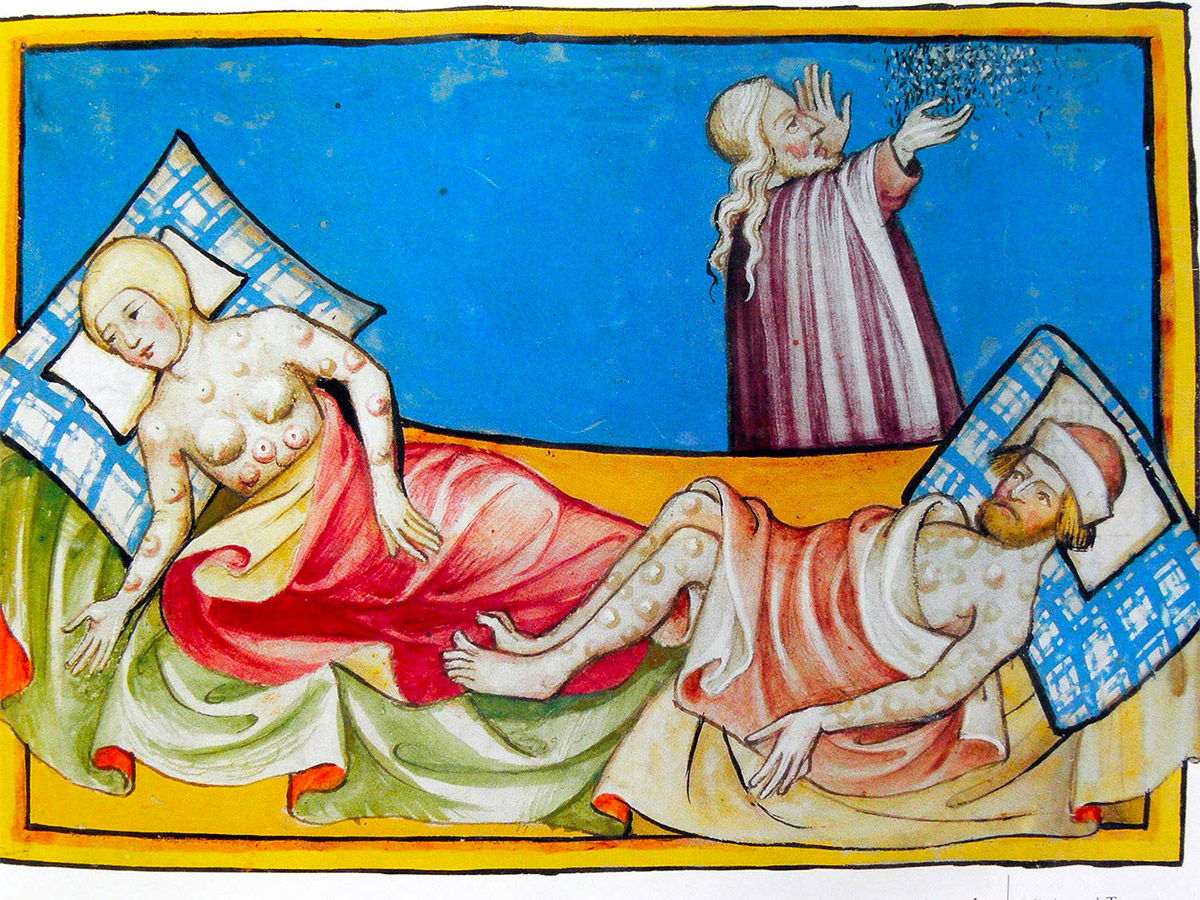
The Black Death: The Greatest Catastrophe Ever | History Today

Just as there is at present no cure for COVID-19.there was no cure for the 14th century plague -  medicine being very much in the dark ages. Medical teaching was on lines specified by the Church. In France the few medics there were often succumbed to the disease themselves. There was no knowledge of germs and no fancy masks or Personal Protective Equipment.. They also worked under the disadvantage of being seen as secondary to the Church. If a victim required their attention he might  have to go to confession first. The patient might then treat the value of his advice the same way he would treat going to a priest.

The only cure was to move far away. Only the rich would have the means to do this. Exceptionally Pope Clement VI In Avignon simply holed himself up in his chamber in the Papal Palace in Avignon with two huge fires and saw no-one. Most attempts at quarantine were unlikely to work. Today we note the anger in France and the UK when people with second homes go into the country causing strain on local resources, just as country locals in the 1340s resented the rich leaving the sinking (or stinking) capital cities.

Otherwise there was a raft of peculiar and ineffective remedies which would not save lives. Eating figs before breakfast, filling the house with flowers and sprinkling rose water and vinegar on the floor were some ideas.

Put simply : there was complete ignorance about how the plague spread and how to deal with it. A common view was that it was caused by an evil miasmatic cloud enveloping the area. Others thought it was through person to person contact. Ignorant people look for an explanation they can understand and when they get frightened they find a scapegoat. In particular lepers and Jews suffered frightful persecution as a result in parts of Europe. Where are our scapegoats? Probably  politicians.

The Church took the line that the plague was God’s will and a punishment for the sinfulness of man. Unfortunately they had not made enough fuss about this earlier and  this did not go down well with dying people all around. Many people will have believed it was God’s will but believed in God’s mercy. The sinfulness would be wiped out by suffering. In St Albans Abbey holy relics would have been brought out and penitential services held  to placate God. Some abandoned themselves to eating and drinking for tomorrow we die. The scale of the pestilence and the indiscriminate character of those who died was shocking. Death had always been a preoccupation and now it became an obsession. It was all to no avail. It could not be stopped. The Church was seen to be unable to defend itself or its people.

King Edward III was in his prime and wanted to show leadership and lack of fear in the face of the plague. Despite the Plague he went on a bold adventure to Calais in August 1349 with a group of knights to foil a plot which would enable the French to retake it. Also by the ostentatious tournaments he held throughout the country to show himself and the foundation of the Order of the Garter at Windsor Castle he sought to raise spirits and show who was in charge. Personally he had had to bear heart-breaking  deaths  in his family. He had lost a three month old son, William in September 1348 and a beloved 14 year old daughter Joan. She had been on her way to marry King Pedro of Castile on 1 July 1348. However I believe this does not mean that he was reckless. He was staying out of the limelight  at his palace in King’s Langley (only about 10 miles from here) from February to April 1349. He will doubtless have become aware of the dire happenings in the Abbey here. Kings had regularly visited here in the past.

Joan of England (1335–1348) - Wikipedia
Princess Joan

Monasteries suffered particularly badly over all Europe. Communities living in close quarters were sitting ducks for infection. The monastic orders had about 17500 members in 1348 and lost around 50% in the plague.

St Albans lost 47 including the Abbot and the Prior, Never would they be able to reach 100 brethren again and it was a struggle to keep to 50 throughout the rest of the lifetime of the Abbey. The following years were hard. The good news was we were lucky to have a new Abbot, Thomas de la Mare, who was experienced and destined to lead us through some of our greatest days. At the start of his rule he had to go to Avignon to have his position confirmed by the Pope, as was customary then./ The journey was hazardous, the cost extortionate and two of his companions died en route, Inn his return journey he himself was extremely ill ifor several weeks and only just recovered. Whereas in many places  in England  the replacement ecclesiastical leaders were of lesser quality in the 1350s we bucked the trend in St Albans. The conduct and liturgy in the Abbey was seen as a prime example of good practice. Thomas was an official Visitor at other Benedictine foundations and on occasion monks from elsewhere were seconded in order to experience good practice.

There were dramatic effects on daily life. The planned Parliament of 1348 was cancelled. There was no facility for virtual meetings  then! Historians continue to disagree about the economic effects of the plague. There is a view that the country was overpopulated before the plague for the jobs available,  and this helps to explain the quick recovery in some places. There is evidence that in some areas dues were still paid to landlors and agriculture continued. Doubtless it was patchy. We were fortunate in the estates controlled by the Abbot of St Albans to be able to make a good recovery through sufficient labour and good management.


So how disastrous was the Black Death for us in St Albans and the country? I cannot overstress that there was still the  fear that the Plague would return. There was an atmosphere of doom and this was fully justified. There were further bouts of plague in 1361/2, 1368/9, 1371, 1375, 1390 and 1405. The 1361 plague was particularly vicious and took as much as 20% of the population , especially younger men. God had  not been satisfied. The Church had lost face. Why had so many good churchmen died in 1349/50 and why did it keep returning? How could it be stopped? No wonder some must have adopted a fatalistic view of life.  Despite this London seems to have made a good recovery  and reached 35,000 by 1377.

Our present experience in 2020 will be more catastrophic economically. The uncertainty of when and how to stop the lockdowns will become acute. The magic vaccine is unlikely to appear for  at least a year. Easter will be very different this year. No choir or organ playing for me - the first time for over 20 years! Social distancing of two metres and the closure of churches is new to us. Pope Francis giving us his blessing in an empty St Peter’s Square is an image which will stay with us forever. We will gather round our electronic gadgets this Easter watching streamed services with a lone priest presiding. No foot washing in St Albans Abbey today, Maundy Thursday 2020.

Friday, August 2, 2019

Beer

"How many pints did you say monks drank in a day?"

"Scandalous ; how did they do it? And the nuns too...Maybe it was weaker! But they couldnt drink the water could they?"

St Benedict does not speak of beer in the Rule, but remember this was written in Italy in the 6th century. He does mention wine - "half a pint daily is enough" I shall cover wine in a later post... But I think the message is clear : Western monks have not been traditionally denied alcohol.

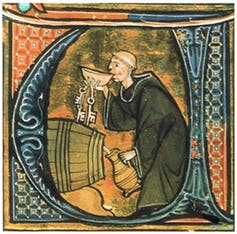
Monks have been brewing beer since at least the 5th century and at the peak   over 600          monasteries were doing it. It was customary to try to be self-sufficient and production had to cover pilgrims and visitors too.They believed they were doing God's work and therefore it should be done well and be good. The cellarer and sub-cellerar were expected to ensure ale was well made, a good colour from good malt with a good flavour. Punishment from senior monks could follow poor practice.In 1515 the ale given to monks at Ely was said to be only fit for pigs! The Prior was told to improve it forthwith so the monks had no reason to go inth taverns in the town!  In the quest for making more and more beer they eventually added hops in the 15th centuryto balance the sweetness of malt and act as a preservative.

I think it is better to think of the beer which monks drank as liquid bread. In fact after bread itself beer was the next most important way to get the calories, minerals and vitamins to keep them going.
Ale plus mixed grain bread would provide much of what a person required except for vitamin C. Imagine a monk in a cold monastery chanting hour after hour. This took stamina: the standing, sitting, kneeling plus the amount of singing. Perhaps all 150 Psalms in a week! They would need a drink all right! I believe it was this liquid bread that is the key to how they coped.In the late 15th century monks at Westminster were allowed a gallon (yes 8 pints) a day. Outside meals they might even have more, especially if they had had to sing exceptional psalms. The precenter could expect more after singing a long office on a feast day.It has been estimated that alcohol accounted for 19% in energy terms in a monk's diet.Contrast this with a national  average today of 5%.


Clearly the beer they drank was weak by modern standards, maybe like our present pale ale. I am still somewhat puzzled how they managed to down 8 pints in a day with only one major meal plus perhaps a light breakfast and a drink at the end of the day after Compline.The latter evidently became the norm in some institutions (even the nuns at Ankerwick Priory apparently) and had to be discouraged.  Otherwise I imagine monks downing lots of pints at the main meal and or crafty pints at intervals somehow somewhere. And those main meals were meant to be silent....No wonder there were reports of instances of strange hand signals and noises at meals...It remains a puzzle. and I believe 8 pints was well above the norm for most places at most dates. It might be thought that the senior monks were the worst culprits but not always, for Abbot Wulfstan of Worcester pretended to drink ale or mead after dinner and in fact it was water. Only his servant knew.


People in the Middle Ages will have had a tougher constitution than us, and were able to eat and drink things which we would or could not safely stomach. Water was dodgy but did vary. Stream or pond water was better and different from  brackish and salty sea water. Water was sometimes boiled before drinking. Also it was used to dilute other drinks like red wine.

 It was ale which was made first from various malts  including barley, wheat, oats and mixed grains. It was made in smallish batches because it had to be drunk within 2 weeks. It could be flavoured in various ways  with herbs, nettles etc. This could make it thick, nutty, light, or  flowery. Often ale had yeast included. These yeasts might be in the air, or on grains or fruit and would affect the flavour. Our modern yeasts come from Germany. In the Middle Ages we would have used our own milder yeasts for ale.


In the 15th century hops began to be added and this made the drink more bitter but enabled it to be kept longer periods and made in  much larger batches.Abbeys were in the forefront of this change and invested in large vats, tubs and barrels. However ale was still populat as some monks would prefer the sweeter ales to the newer bitter beers.

So monasteries and nunneries had their own brewhouses. It was big business and monasteries needed to invest in them. Norwich Priory in 1263/4 spent £2.15.11 on materials and £1 on building a new lead roof for the brewhouse and bakehouse (these were often grouped together).It was a lot then!  In the later Middle Ages monasteries would invest in large vats, tubs and barrels. Big cellars could contain many barrels of
the hopped beers.

What did brewhouses look like? Lacock Abbey in Wiltshire was an Augustinian nunnery. The new owner after the Supression of the Monasteries in 1539 was Sir William Sherrington. He kept a brewhouse which still has its furnace, vats and cooling tanks which replicate the medieval ones.

Lacock Abbey brewhouse : mash tun cooler and fermenting vessel (Jordin57 on cc flickr)


Brewing was most often done by women - perhaps the wives and daughters of  the official named brewer,

Going back to really ear;ly monastic practice. The famous 9th  century map of St Gall in Switzerland shows 3 breweries - one for visitors, one for pilgrims and one for the poor. By 800 this had become an imperial abbey. I am not suggesting that Emperor Charlemagne actually came through and binged in the abbey but it is possible to suggest via this plan that by 829 beer was being brewed here. It is a matter of opinion whether the abbey looked something  like the plan or whether this is an idealised abbey plan.

Image result for st gall monastery plan BREWERY
Model of  St Gall derived from the plan

Moving fast forward to the present : today there are at least 24 monastic breweries in Germany : some from ancient monasteries, others in newer foundations.Several are now privately owned  but kept the monastic name and style (eg Weihenstephaner).Half of the breweries are in Bavaria and are great tourist attractions. Klosterbrauerei Weltenburg is the classic example. It is on a picturesque bend of the Danube not too far from Regensburg. Although founded in 620 beer production only began in 1050! In my travels to Baroque churches I first visited this wonderful monastery by train and walked about 5 miles from the station. After the stunning  church  by the Asam brothers and  two large glasses of Weltenburg Kloster my walk back was positively jet propelled.


Kloster Weltenberg
Kloster Andechs with its double altar and grave of Carl Orff boasts a huge beer garden serving the light Andechser Bergbok Hell and dark Andechser Doppelbock. Beer production started there 1391.


Now we have English Trappist monks making beer in England for the first time! Tynt Meadow is mahogany in colour with aromas of dark chocolate, liquorice and rich fruit flavours.Made by the monks of St Bernard Abbey near Coalville, Leicestershire it will be something between a strong brown ale, a barley wine and a dark porter. Sounds lovely....It is replacing their dairy farm which was not sufficiently profitable. It must still be secondary to their normal work and way of life and help to fund their living expenses, the grounds and various charities.

Brewhouses were obviously common in the Middle Ages. They are still being found. For example excavations have discovered that Bicester Priory had a brew house which was excavated in 2013 under the site of a former care home.

What  about St Albans? 

We know there was a brewhouse for the Abbey and it may have been situated near the river Ver near  the mill beyond present Fighting Cocks pub. It was a rather larger river than the present stream! We know a little about standards : Matthew Paris tells us in his Chronicle that Abbot John had to improve the beer  drastically as it had become unacceptably weak.He therefore set aside 1000 loads of barley and oats suiable for making better beer. Presumably standards improved and the monks became happier.


Reminders  of earlier ale houses are around me every time I step into our city. Alleys around the market place with names like like Lamb Alley and  Boot Alley.  As I go through an ancient alley featuring a 15th century grotesque.into French Row I feel very near to the generations who have smoked or relieved themselves here.


St Albans has a special in the beer world as the birth place of CAMRA. (Campaign for Real Ale) On 20 November 1972nMichael Hardman, Graham Lees, Jim Makin and Bill Mellor held the first Branch Meeting of what was to become CAMRA in the Farriers Arms in Lower Dagnall Street. The ai,m was to champion te cause of real ale, cider and perry and support a thriving pub in every community. There are now over 190,000 of us who are members! The annual Beer Festival in the main assembly hall of the town (the Arena) in late September seems to get bigger every year with  every nook and cranny in the building plus a sizeable overspill outside filled to bursting.


I dont think I am on this photo of our CAMRA St Albans Beer Festival!


Friday, July 26, 2019

Hororarium : the daily offices


Baroque choir bench end in church at Friedrichshafen, Germany

I guess we often picture  monks chanting away in Latin or praying all day..Certainly this was how they would spend much of their day. It has been called Opus Dei (work of God) or Liturgia Horarium (Liturgy of the Hours).It is about the fixed canonical hours when they came together to pray in word and song. In this post I will consider their whole daily sequence.


Perhaps the hardest part to grasp is the concept of hours whch  vary in length according to the season! We have already looked at this in earlier posts but we have to come back to it again. If we consider there were 12 hour nights and 12 hour days the summer hours were longer (because it was light longer) and the winter days shorter (because it was dark longer). Winter hours started about 13 September and lasted until the start of Lent : Ash Wednesday. Summer hours therefore from the start of Lent until mid September. Another way of looking at it is to say that winter "hours" were 10 minutes shorter than summer "hours"  or that summer "hours" were 10 minutes longer than winter "hours".

The pattern of  prayer in  canonical hours remained the same throughout the year with the same offices or services. The length of these and the content each day depended on whether it was an ordinary day or whether it was Sunday or special in the eyes of the Church so that modifications should  be made. This was most often because it was a Church feast day, and there were lots of these. We think of  Christmas, Easter, Pentecost for example. But there were over 100 Saints' days as well as the major feasts. Together with all Sundays = 150 days a year or 3 days a week. This is important!

In addition the pattern would be affected by times of penitence when prayer would be extended, visitations, hospitality, involvement in secular affairs, dealing with the poor, stocktaking and administration. This meant that not all monks would be at all of the offices.In addition when we start investigating individual monasteries we find evidence of constant rebuilding and the likely consequences in day to day life! (Remember what it was like when you had your kitchen redone....)

Baroque choir stalls and Baroque organ from later centuries


The schedule of eight offices which is quoted  as the norm evolved before the 6th century. Office means a service where monks come together to worship to a specified format. All this was specified in the Rule of St Benedict although not really a Benedictine invention. By the end of the 7th century High Mass was added to the schedule of eight offices and a lesser Mass from the 10th century.

The pattern established in the  Benedictine Rule became the foundation of most monastic timetables of all the monastic orders theoughout the following centuries.The length and time varied but the structure would remain the same in 1500 as in 1200. There would be changes due to abbreviations and extra psalms and prayers. There would be some differences in timing and length due to climate and according to the practice of different Orders of monks.

A good introduction is the BBC "Day in the life of a Benedictine Monk". Watch it here.

Here  is the general pattern :

First there was the NIGHT OFFICE or service held in what we might call the middle of the night. This seems to me the most extreme of all. In researching this I detect that the timimg was changed sometimes due to the season. Length would vary according to the seriousness of the day: which means holy days would have longer celebrations.I do not think we can be sure that these night celebrations always took place as specified. When monastic communities got slacker in their observances it is possible that this is where they slipped down. However I am starting start with the ideal.


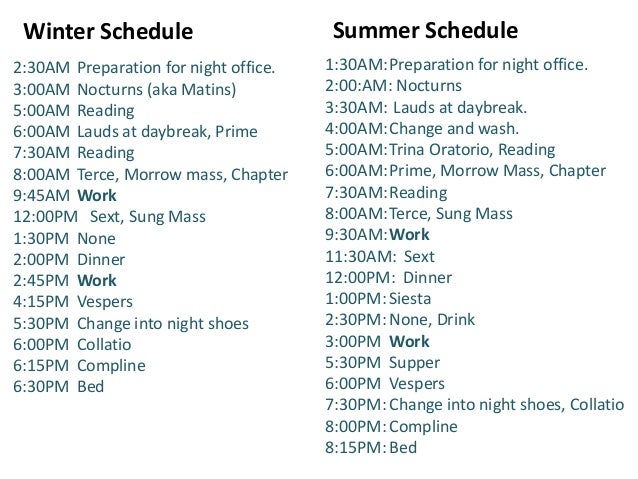
MATINS this is the Night Office. Sometimes called NOCTURNS.The Benedictine Rule sais it should be the 8th hour of the night. This could make it 2.00 am.....in summer it was likely moved back to midnight. It could be a avwry long service on a holy day. Perhaps 2 hours.


LAUDS Sometimes this was sung immediately after MATINS. Otherwise it would be before daybreak.Shorter perhaps 45 miniutes.


PRIME supposed to be sung at Dawn. 30-45 minutes.


TERCE shorter office - about 30 minutes

(Light breakfast sometimes)
Chapter meeting

SEXT shorter office - about 30 minutes


HIGH MASS important and lasted about 60 minutes

 (Dinner)

NONES shorter office -about 30 minutes


VESPERS longer office - 60 minutes

(Supper sometimes)

COMPLINE to finish the day - perhaps 30 minutes


 I have been considering how to make all this simple and how much detail to include. It is impssible to reconcile all the patterns of worship (Honoraria) by monastic communities  that I have discovered! To try to do this would be hedged in qualifications (different Orders, places, times, holy day or ordinary day) so I  am going to leave it at that for the  moment with the addition of the stuff below.
 I shall return in later posts about what the offiices included, how they kept awake (or didnt), chanting, how cold it must have been etc etc.


Image result for benedictine day

Sunday, June 16, 2019

Monastic Time


So how did monks tell the time? We have explored the more theoretical side of time in an earlier post and now we get to the specifics. Up to the early 14th century monks used a combination of water, sundials, the stars  and marked candles to measure time. The development of mechanical clocks in the 14th century began to change this. We  left behind the old process of variable hours with their long winter nights and long summer days and moved into the fixed uniform straitjacket  time we have today, where we chase every minute!

How did this happen? It was probably via astronomers searching for accurate instruments for observing the planets. They may have sought a new piece of apparatus ; a sort of disk which would rotate along with the earth. We call this an escapement. Such a device was likely invented in a Benedictine monastery in the early 1200s. There is no agreement where and when and it was probably not intended to replace existing methods of observing time. It was later that the potential for timekeeping of this regular circular motioned device was appreciated. An escapement refers to any machine which breaks up circular motion into regular ticks.

This regular movement was to produce devices which were not well suited to measuring days which were unequal. A collision with canonical time was going to come.

The earlist known clock was at Norwich Cathedral Priory - operational around 1273. This was replaced by a bigger one there in 1321-5. Some other examples were at Christchurch, Canterbury, Ely, Exeter and St Paul's London. They were all expensive for they required teams of workers with differing skills to create.The earliest remaining clocks can be found in Salisbury Cathedral (1396), Rouen (1389) and Wells (1392).


Astronomical clock at Wells Cathedral first installed 1386-92
Then the  rise of town clocks led to 24 hour regular divisions of 60 minutes. This was not just a technical matter but involved the ringing of bells in a medieval town. In the 1300s people began to speak of o'clock rather than the canonical hours. Births and deaths and business took this up. Secular society was gradually separating from the hours dictated by the Church. This suited trading cities like Genoa and Venice. Guilds could also control hours of work.

However the Church was  not keen on losing control of the 24 hour reckoning of time. It implied that time was abstract and measurable rather than part of the natural order. People could start to consider allotted time and the best use of it. Early clocks were marked with "memento mori" reminding people of the shortness of life. Time could begin to be seen as part of a person's life or for others to exploit a person.Modern time reckoning was an affront to the power of the Church over time and to some even seemed to take away God's power over time.

As we all know the  new method of time reckoning won and canonical hours eventually became attached to it too.

This process can be charted as well anywhere in St Albans.


St Albans

Before  the 13th century our Abbey was using so-called canonical hours : 12 during daylight and 12 at night. The intervals between these varied according to the season. Summer time had longer daylight and a shorter night and vice-versa. Commercial pressures sometimes led to the hours to be more fixed lengths. For example the None - originally the 9th hour mid-afternoon office had become mid-day or noon. Therefore the laity were beginning to use time divided into 24 equal hours. The Church was losing its monopoly of time.

A clock controlled by local laity could lead the working day of the town by regular chiming every hour. The Church rang the opening and closing of markets and the working day. There was a battle for control here.

Richard of Wallingford was one of our most learned abbots  (1327-1336). He joined our monastery in 1308, studied gammar and philosophy at Oxford until 1314, ordained priest 1317 ; returned to Oxford to lecture.  It was then he got into maths and astronomy. He wrote a treatise in Latin on the design and construction of astronomical instruments and a clock to ascertain time and the position of stars, sun and moon. After his return to St Albans in 1326 he became abbot in 1327 and spent much time and  money on an astronomical clock. This became such a priority that King Edward III told Richard he would have been better spending money on restoring the abbey buildings (there had been the major collapse of several bauys in the nave in 1323). Richard apparently replied that his successors could fix the buildings but only he could do the clock. Alas he never saw it finished because he died early from leprosy. It was his successor, Michael de Mentmore, who completed it. It likely stood in the south transept and had bells, dials and wheels showing the course of the sun, moon and stars as well as the time . I think that Richard's clock was initially about daily monastic routine but also ensuring the Church's superiority and  keeping control of time.

Richard's clock disappeared with the dissolution of the Abbey. Today you can see a full size replica made by enthusiasts here in 1995 in St Albans Cathedral. This was made possible by Richard's original notes being found in the Bodleian in 1965 and the painstaking translation work of Professor John North. The replica clock does not have hands but is designed to chime every hour.This provides the drive for showing the position of stars  currently visible over St Albans.The position of the sun is shown via an engraved disc and a numbered grille indicates the current time as on a sundial. The phase and position of the moon can also be seen. A detailed booklet is available in the Cathedral by Alan Loomfield for clock and astronomical experts.

The Wallingfors clock (flickr cc by Keith H)


The bell (Gabriel) (flickr cc by Russell McGovern)
Clock tower in St Albans (flickr cc, by Richard Gillin)


This was not the end of the matter because from 1403-1412 a clock tower was built in the market place. It survives to this day and is a popular tourist attraction, showing what a secular medieval clock tower was like and providing a great view over town and country. It was likely built as a protest by the townsfolk against the  time monopoly of the Abbey. The original bell (christened Gabriel) was cast in Aldgate, London by William and Robert Buford sometime before 1418. It is believed that it sounded the angelus at 4 am and curfew at 8 or 9 pm. The curfew was last rung in 1863!The last time it rang out by being swung was for the funeral of Queen Victoria in 1901! Today it  is still sounding out an F natural on the hour albeit by being struck on its side, as the oak frame that holds it is too weak to allow swinging. Back in 1412 the  clock mechanism likely had no face and the poor clock keeper who lived in the tower had to strike the hours manually! It is unlikely to have been very accurate  and the clock mechanism was replaced in the 18th century with hands and face. The present clock dates from 1866.

It is a fascinating building and open to the public Saturdays, Sundays and Bank Holidays from Easter to October 10.30-5.00. Staffed by volunteers  including myself occasionally!


Thursday, June 6, 2019

Haircut time for monks

Every time I venture into the town I pass a new barber shop. In 2019 we seem to be obsessed with having our hair cut. Women spend a fortune, quaffing  wine while having highlights added ; men go for that little tidy up so often....St Albans is full of barbers just like any town today. It wasn't like that in the Midde Ages. Hair was long, except for  those in religious orders or for felons as a punishment.

In those films we used to see jolly Friar Tuck always had a bald head save for that circle for hair round the edge. That was what we expected. I had never really thought about it until last week. Why did they have this haircut and how did they get it?

By our period it had been established that monks had their hair cut short. Generally when they became a novice their hair was cut drastically with shears. These were the medieval scissors - two oppoing baldes connected by a flat metal bow which acted as a spring to hold them togther.

When they made their prpfession and formally became a monk the top of the head was shaved leaving a bare patch surrounded by a ring of hair. This symbolised the crown of thorns put on the head of Christ before the Crucifixion. This was called receiving the tonsure. It was performed using a knife called a rasorium or novacular. (very much like what we call a cut throat razor). I told my barber this yesterday as he trimmed my sideburns - he didnt seem impressed....

Lay brothers did not have the tonsure. Cistercian houses had large numbers of lay brothers (conversi) to help the daily running of the monastery.They were formal members of the Order and took vows of obedience but their main focus was on manual labour.

Medieval shaving


The cutting of hair and shaving was usually done in the cloister, where there would be a source of water and plenty of light. There were no mirrors so light would be advantageous.No soap and hot water likely only for softening the beard. It must have been pretty unpleasant. It was often done just before a big Feast day like Easter, Christmas etc. as a preparation for the holy celebrations. Cistercian monks were thereby shaved 7 times a year in the 12th century. In the later Middle Ages more frequent shaving was likely : perhaps fortnightly in summer and every 3 weeks in winter. Shaving was sometimes done in pairs or one "expert" monk could perform it.

Saturday, April 20, 2019

The concept of Time

We all expect to be able to tell the time instantly. Monks will have had a completely different idea of time. I like to think that I know the time throughout the day and during the night too. I am often correct in daylight and during the night have developed an uncanny knack of being mostly surprisingly accurate. This is partly because I am used to referring to a watch or clock so often. I can remember at work when the office clock was broken how often  I kept looking at it! Quite shameful.

Main entrance
Clock Museum, Furtwangen in the Black \Forest, Germany

Consideration of the concept of time could invoke yawn. The more I have considered it, the more fascinated I have become. Our visit to the Deutsches Uhrenmuseun (German Clock Museum) at Furtwangen in the Black Forest, Germany in the summer of 2017 is to blame for kindling my interest.
I began to appreciate the importance of sundials, water clocks, candles and the role of the Church. Furthermore the Abbey in the village where we were camping had a famous 18th centuryBaroque wooden gear clock with the seven days of the week and the planets. (A successor to our own early 14th centuryWllingford clock).

We have to understand that before the 13th century monasteries were very often in charge of telling the time, not just for themselves but for people in many towns and villages. The canonical hours by which monks knew when to hold their offices (services), eat, sleep and pray were also  being used by everyone else as a yardstick to mark the passing of time. Medieval times could be filled with chaos and violence and monasteries alone could provide some stability. Merchants in 12th century Genoa, for example, referenced times of major business transactions, births and deaths by the use of canonical hours.

Next we have to understand these canonical hours were fluid by our standards. Not really fixed at all. It has been hard for me to grasp this. Canonical hours are about scheduling a series of particular events (ora et labora = praying and working) so the length of hours was geared to accomodate these. In addition day and night were divided into hours separately with the length of the day altering according to the seasons, particularly in northern Europe. Hours became signaled by bells manually.

Think of  the poor guy who had to ring them know when to do it? There must have been mistakes!
Great material for a Monty Python sketch....

It was the responsibility of the sacristan and he would need a kind of alarm to do his job. This was before the mechanical clock.....so he might use candle clocks, sundials, and the stars, possibly  using an astrolabe. Clearly errors would be made and time therefore was fluid in a way we would not understand or tolerate.

Christian philosopy also supported this fluidity : St Augustine saw creation and God eternally linked. There developed a view that time and natural cycles of season, sun and heavenly bodies were given by God to use to measure time. Observation of nature became key. Sundials measured the position of the sun, astrolabes the heavenly bodies. Even waterclocks, as we shall see, had to be reset every morning with a sundial. These devices just reflected the natural order rather strictly measuring it.

.An 11th century document tells how a sacristan stood at a designated spot and would know from the position of a paticular constellation of stars when to ring for the Vigil. For example when the Twins were just about over the monk's dormitory and Orion was over the All Saints chapel on 25 December it was time : earlier in fact than usual because it was a Feast day with a longer liturgy.


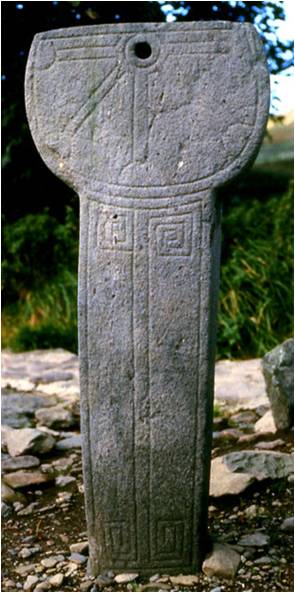
Sundials had been used since the time of the ancient Greeks. Use .of a sundial divided a day into twelve sections  regardless of the season. This meant shorter days in winter and longer in the summer. Of course sundials require sunlight and are not good in cloudy conditions or at night. There are very ancient examples of use by monks in Ireland. Made of stone, they were set in open areas on ground well clear of shadows with face to the south. A horizontal hole in the centre of the stone face held a pointer made of iron or wood called a gnomen. This cast a shadow along lines on the stone indicating the time of day.  Nine of these ancient sundials have survived. Their main purpose was to indicate canonical hours (when the  offices of the church were to be said). : for example at Kilmalkedar on the Dingle Peninsula, Co. Kerry.from the 9th century.


Kilmalkedar
Sundial at Kilmelkadar


More common from 7th to 14th centuries were Tide Dials (or scratch or mass dials) on the south wall of churches  : again marked with canonical hours rather than (or  in addition) to daylight hours. These were certainly used in Saxon times becoming less popular after 1066 with the coming of te Normans. There are some 3000 examples in England. We came across a tiny one outside the priest's entrance to the chancel at Burford church  last year!


Here is a much later one at Sherborne Abbey showing the gnomen very clearly.


Sundial at Sherborne Abbey


Photo from flickr © Becky Williamson (cc-by-sa/2.0)

I must share this image : today by an amazing coicidence I was researching for my other blog Baroque Churches about a church in southern Mexico called Tlacochahuaya and on their web site I was greetetd by this sundial from the late 16th century in the churchyard put there presumably by Dominicans when they colonised the area and built the church!


16th century sundial at Tlacochahuaya, Mexico

Below is another rather more picturesque example of a sundial on the side of  a small chapel we saw  on a walk  near Meersburg, in south Germany., in summer 2018.


So how about at night or on cloudy days? The measuring of time was also done by using candle clocks and water clocks. The candle clock is sometimes connected to King Alfred the Great. A particular sized candle is found to take a measurable time to burn and thence time can be measured by burning a set number of these. This little video summarises the good and bad points of candle clocks rather well.


Water clocks (or clepsydra) were useful at night  except in very cold weather when the water might freeze! Using the same principle as a sandtimer or hour glass, they operated by filling and emptying a vessel at a controlled rate. It's the way I used to time my boiled egg with a sand--driven egg timer!
A source from Gottweig (Austria) says the sacristan would set the device carefully and when in the morning it "fell" he was to rise and if the sky was clear, check the time against the stars. Then if satisfied he was to open the door, light candles and set the clock by pouring water from he smaller to the larger basin, pulling the rope and the lead up and striking the bell. Possibly te device had    a float on the dropping surface of the water connected to a counterweight. Thus the wake up call to the sacristan was acoustic but not yet connected to the bell.
Premonstratensian statutes mention a device that made a sound and awoke the sacristan, who could set it so that it could be tripped to ring at certain times.
Evidence of their use in monasteries can be verified by Jocelyn de Brakelond using the water to put out a fire in his abbey at Bury St Edmunds  in 1199!


I think  monks used a combination of water, sundials and marked candles to measure time. But it still must have been approximate by our standards.

Now we will look at how time was relayed. Bells! But which bell? What did it mean? It would have been much quieter in the Middle Ages (no traffic noise...)and bells would have been more audible. Also I think a tolling bell would have gone on long enough to be heard.

The sacrist in a monastery was responsible for communicating the daily routine, when to get up, when to go to an Office, when to go into the chapter house, when to eat, and also when an important guest arrived, or the death of a monk. This meant choosing a bell or device and ringing or striking it in such a way that it conveyed the message. A large bell might denote major Hours like Lauds, Compline, Nocturns  or Vigils. A smaller bell might denote thde less important Hours : Prime, Terce, Sext, None. A little bell might denote time to eat or drink. A full peal of bells would be used for an important visitor. The death of a monk might be announced by using a wooden board - struck with sharp hard blows. Such a device was used at Bury St Edmunds. This may have been unusual because it is the Orthodox who used wooden boards called semantrons, from the 6th century before bells. There were even far more wooden semantrons in Constantinople than bells in 1453.

Bells were important and do we all remember "Frere Jacques, Frere Jacques. Dormez-vous, dormez-vous? Sonnez les matines, sonnez les matines, Ding dong ding ! Ding dong ding!" because that is what it is about!

Another example of how monks have got linked to ringing bells is this early Black Forest Monk Clock which I cann ot resist showing you!


There were cases of monasteries containing different orders of monks with differing timetables and therefore bells being rung and causing consternation and confusion!  This might even be done deliberately!

I suspect this may have been happened in St Albans with the town clock tower and Abbey bells. But I am jumping ahead. I shall cover this in a later post. The first known bell in St Albans Abbey was in Saxon times and given by a Wynfled in 1043. Abbot Paul de Caen put in 2 bells in the new Norman tower in the later 11th century and in succeeding centuries 3 more were donated. We can presume a maximum of 6 bells in the Middle Ages.


I